Introduction
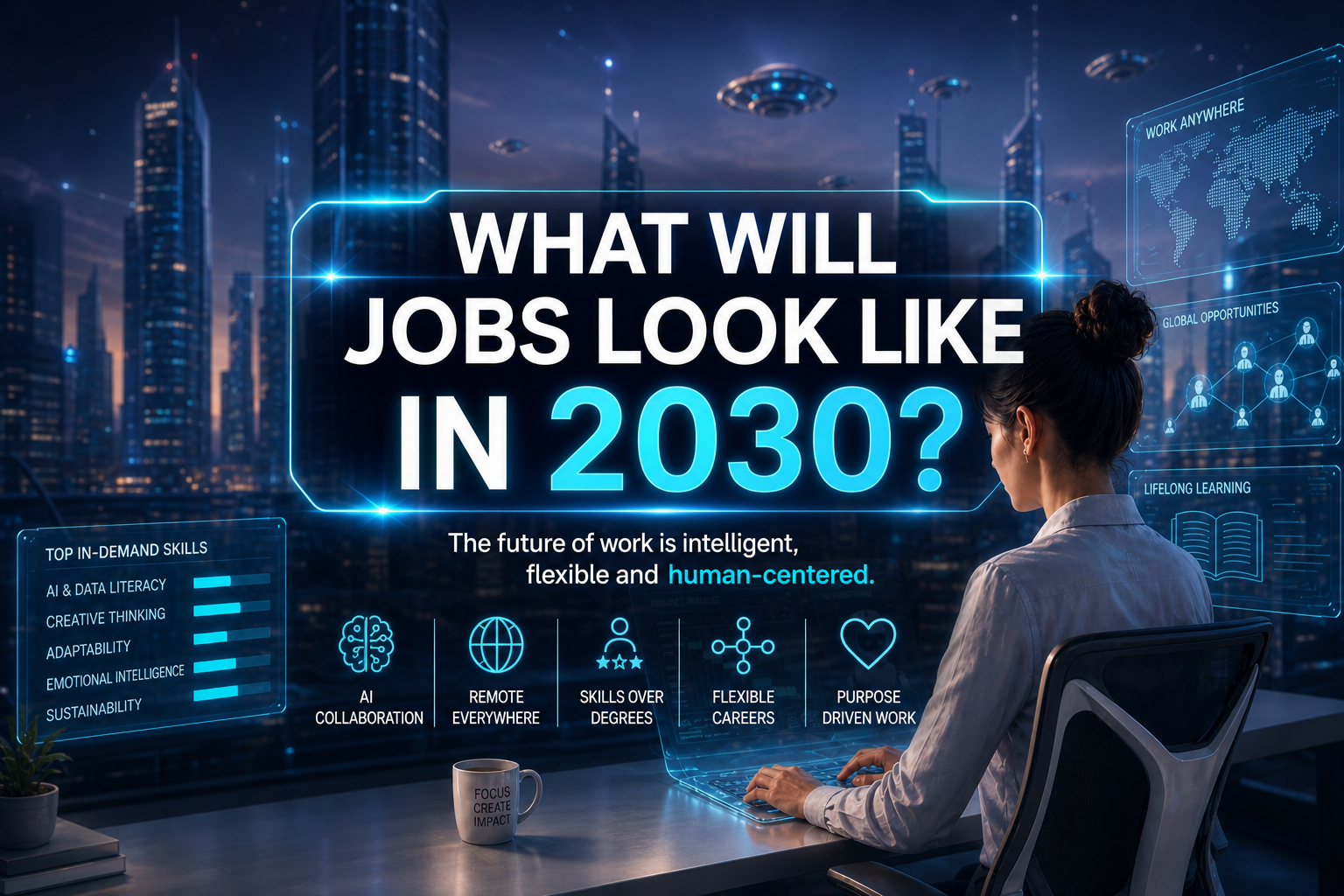
When people think about jobs in 2030, they usually imagine either a four-hour workweek on a beach or a sci-fi dystopia where a smart toaster is your boss. The reality is much more practical. The workplace is changing rapidly, but the future of work is not about replacing humans. It is a major upgrade to how we spend our days. Here is a realistic breakdown of the professional landscape at the end of the decade.
AI as a Co-Pilot
AI will take over certain tasks rather than entire jobs. By 2030, artificial intelligence will be as integrated into daily workflows as Wi-Fi. We are entering the era of the augmented worker.
Outsourcing the boring stuff: Algorithms will handle repetitive work like data entry and sorting spreadsheets. They never need a coffee break anyway.
Shifting your value: Your career value will no longer be measured by how quickly you process information.
Asking the right questions: You will be valued for your judgment, strategic thinking, and ability to prompt AI effectively. People who thrive will know how to manage AI tools to improve their output tenfold.
The End of the Standard Workday
The standard work schedule was built for factory production. By 2030, sitting at a desk just to prove you are working will be completely obsolete. Companies will focus entirely on your output rather than your hours.
Working on your own time: You will be evaluated on the work you deliver. You can write code late at night or design graphics in the afternoon.
Global remote work: Remote work will be the default structure for most businesses. You will collaborate with a global workforce instead of just local colleagues.
No more fake typing: You will finally be free from pretending to look busy when the manager walks by your desk.
The Value of Soft Skills
As machines get better at coding and analyzing, human-centric skills will become highly valuable. When technology makes technical abilities common, your competitive edge is your humanity.
Connecting the dots: Complex problem-solving will be essential to connect ideas that machines completely miss.
Handling the human element: Emotional intelligence will be critical for leading teams and empathizing with clients.
Staying adaptable: The ability to learn new methods quickly will serve as a strong safety net. Technology changes fast, and you will need to keep up to stay relevant.
AI-Powered Jobs by 2030
Companies across every industry will need people who know how to use AI practically. Here are a few realistic roles expected to grow by 2030.
AI-Native Product Designers: AI can write code, but we will need human designers to build minimalist, premium interfaces. Their focus will be giving users an Apple-level polish and enough breathing space so digital tools feel calming instead of cluttered.
Preventative Wellness Analysts: These experts will use AI to analyze daily habits. They will design personalized routines like automatically triggering a 1-minute calm breathing exercise right before a user experiences high stress.
Algorithmic Wealth Strategists: Financial advisors will use AI to run market simulations instantly. They will act as strategic consultants helping clients optimize cash flow, whether saving ₹5,000 on monthly expenses or securing a ₹10,00,000 investment.
Procedural Level Architects: These developers will train AI models to dynamically generate balanced game levels. This is highly useful for logic-based mobile sorting games, ensuring the gameplay remains fun without endless manual design work.
Precision Agri-Tech Planners: Planners will use AI to analyze weather and soil data. This helps farmers know exactly which crops to plant to maximize yields while conserving resources.
How to Prepare
The 2030 job market will reward continuous learning. Education will not end with a diploma.
Keep experimenting: Test different workflows and play around with new AI models to see how they can speed up your daily tasks.
Build real connections: Focus on building a network of genuine human connections. A robot cannot replace a solid professional referral.
Stay in control: You have the power to shape your career right now. Algorithms will handle the busywork, but the creative work of building the future relies entirely on human beings.
Conclusion
Jobs in 2030 will not be about competing with machines but working alongside them. As AI handles routine tasks, human value will shift toward creativity, judgment, and connection. The future workplace will be more flexible, skill-driven, and focused on real output rather than time spent. Those who stay adaptable, keep learning, and build strong human relationships will be best positioned to succeed in this evolving landscape.